


 PLATFORM UPDATE:


Universal non-destructive interconnection layer engineering for efficient and stable perovskite tandem photovoltaics

Abstract
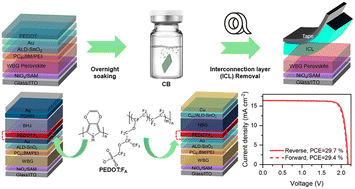
Aqueous poly(3,4-ethylenedioxythiophene):polystyrenesulfonate (PEDOT:PSS) solution, universally employed on the interconnection layer (ICL) in all-perovskite and perovskite/organic tandem cells, has the intrinsic risk of perovskite instability induced by moisture erosion. Here we identify the root cause of instabilities caused by conventional PEDOT:PSS. Moisture from the aqueous formulation penetrates downward through the ICL during device fabrication, chemically degrading the underlying wide-bandgap perovskite and irreversibly reducing device efficiency and stability. We replaced PEDOT:PSS with an isopropanol (IPA)-dispersible PEDOT. This stable hole transport material eliminates moisture-induced damage while maintaining uniform, non-destructive coverage on the ICL, effectively resolving the long-standing limitations of aqueous PEDOT:PSS. In addition, the introduction of IPA-dispersible PEDOT reduces buried interfacial recombination in the narrow bandgap tin-lead perovskites and improves hole extraction. As a result, all-perovskite tandem cells achieved power conversion efficiencies of 29.7% (certified 29.6%) and perovskite/organic tandem cells achieved a PCE of 26.5%, and retained 90% of initial performance under continuous 1-sun operation for over 534 hours and 403 h, respectively, demonstrating their universal applicability and reliability for efficient and stable perovskite tandem photovoltaics.
- This article is part of the themed collection: Celebrating Nam-Gyu Park’s 65th birthday
 Please wait while we load your content...


