


 PLATFORM UPDATE:


Nanoscale chemical imaging of pseudocapacitive charge storage in MXenes
 ab
Louis
Godeffroy,
a
Peer
Bärmann,
a
Faidra
Amargianou,
ab
Andreas
Weisser,
ab
Zoé
Dessoliers,
ac
Mailis
Lounasvuori,
a
Markus
Weigand
a
and
Tristan
Petit
*a
ab
Louis
Godeffroy,
a
Peer
Bärmann,
a
Faidra
Amargianou,
ab
Andreas
Weisser,
ab
Zoé
Dessoliers,
ac
Mailis
Lounasvuori,
a
Markus
Weigand
a
and
Tristan
Petit
*a
Abstract
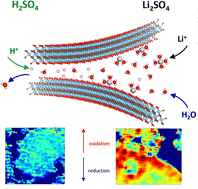
Pseudocapacitive materials store electrochemical energy through fast and reversible surface charge transfer reactions. Titanium carbide MXenes are two-dimensional materials which have shown redox or intercalation pseudocapacitive properties depending on the electrolyte. Nevertheless, the intrinsic pseudocapacitive charging mechanism in individual MXene flakes remains unresolved. Here, we employ in situ scanning transmission X-ray microscopy (STXM) to map the local chemical changes in individual Ti3C2Tx MXene flakes during spontaneous and electrochemical intercalation of protons and lithium ions in aqueous electrolytes. Our investigations reveal that proton and lithium-ion intercalation induces a reduction and an oxidation, respectively, of the titanium atoms in the MXene. This difference reveals a profoundly different chemical origin between redox and intercalation pseudocapacitive processes. By elucidating the interplay between ion hydration, MXene surface chemistry and flake morphology, our study highlights the relevance of chemical imaging in single entities for the fundamental understanding of electrochemical charge storage mechanisms.
- This article is part of the themed collection: Recent Open Access Articles
 Please wait while we load your content...


