


 PLATFORM UPDATE:


Ion/dipole interactions in novel solvation structures for rechargeable batteries: a review

Abstract
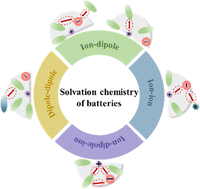
The solvation structure of electrolytes can decide the movement of ions and regulate interfacial chemistries in rechargeable batteries. A variety of novel solvation structures have been reported with the rapid evolution of electrolyte chemistry. This review provides a comprehensive summary of the working principles of novel solvations based on ion/dipole interactions in rechargeable batteries. First, the motivation, development, and design concepts of solvation structures are introduced. Then, the electrochemical reaction mechanisms and corresponding performance of new solvation structures are discussed in depth by systematically analyzing different ion/dipole interactions. Ion–dipole interactions can balance solvation effects to improve the reduction stability of solvents. Ion–ion interactions are promising for fast charge and constructing robust alloy interphases. Dipole–dipole interactions can further shrink cluster size and expand the temperature range of electrolytes. This enables customized solvation structures to meet different application scenarios, establishing a specific design paradigm. Finally, the current issues and possible future directions are highlighted, providing theoretical guidance for innovative designs of solvation chemistry.
- This article is part of the themed collection: Energy & Environmental Science 2026 Review Articles
 Please wait while we load your content...


