


 PLATFORM UPDATE:


Unsaturated coordination-regulated high-spin nickel sites for selective solar-driven carbon dioxide conversion in pure water

Abstract
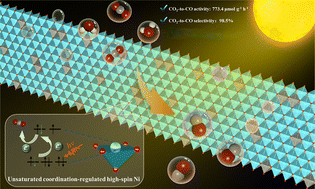
Achieving efficient photocatalytic carbon dioxide (CO2) reduction is crucial for sustainable energy and carbon neutrality. However, a fundamental challenge resides in the rational design and fine-tuning of catalyst active sites. Here, we construct edge-rich nickel–aluminum layered double hydroxide (ED-NiAl-LDH) nanoflakes with abundant lattice O defects for effective and selective solar-driven CO2 conversion in a pure water system. The ED-NiAl-LDH exhibits an excellent carbon monoxide (CO) production rate of 773.4 µmol g−1 h−1 with a high selectivity of 98.5%, surpassing that of state-of-the-art photocatalysts reported in recent years. Outdoor tests also demonstrate an impressive CO2-to-CO photo-conversion rate of 500 µmol g−1 h−1, with stable activity over an 80-hour period. In situ characterization methods and theoretical calculations confirm that the edge-rich structure provides abundant unsaturated coordination-regulated high-spin Ni active sites. The high-spin Ni active sites possess half-filled degenerate eg orbitals in the octahedral field, which significantly accelerates the migration of photogenerated electrons from Ni to CO2 molecules while inhibiting other competitive reactions, thereby enabling the observed exceptional performance. This work establishes edge engineering as a general strategy to unlock high-spin catalytic centers in LDHs, advancing the design of efficient solar fuel systems.
 Please wait while we load your content...


