


 PLATFORM UPDATE:


Towards space compatible perovskite solar cells: guidelines for thermal shock resilience and near space balloon testing

Abstract
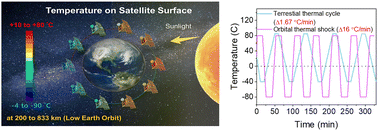
Perovskite solar cells (PSCs) are promising candidates for space applications due to their high efficiency, radiation tolerance, and high power-to-mass ratio. However, the harsh space environment introduces stressors such as thermal shock (TS) from rapid temperature transitions in orbit, a degradation mode that remains underexplored. This study investigated the real operating temperature profiles experienced by solar cells orbiting in low Earth orbit, revealing rapid and extreme temperature transitions. Based on these findings, we developed an accelerated TS testing protocol, cycling PSC devices between −80 °C and +80 °C at a rapid ramp rate of 16 °C min−1 for 100 cycles, designed to replicate and amplify the stresses induced by actual orbital thermal cycles. Using FAPbI3 as a model system, we explored the impact of varying concentrations of MAPbBr3 (0–7%) on the perovskite film's structural stability under this accelerated TS. Our results indicate that an intermediate MAPbBr3 incorporation level (specifically 5%) most effectively suppresses microstrain and the formation of the detrimental δ-phase after TS exposure. To validate our laboratory findings under near-space conditions, we conducted a comparative high-altitude balloon test at 35 km. These findings establish TS as a critical testing framework for evaluating PSC stability in space applications and highlight the necessity of refining material compositions for space applications.
- This article is part of the themed collection: Recent Open Access Articles
 Please wait while we load your content...


