


 PLATFORM UPDATE:


Self-optimizing metal-free porous reactors with dynamic active sites unlock record oxygen reduction activity

Abstract
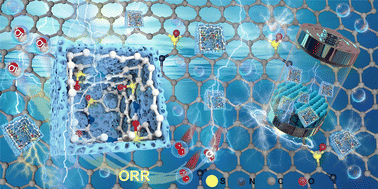
Efficient metal-free catalysts are crucial for advancing aluminum–air batteries (AABs), yet their development has been hindered by poor electronic structure optimization and sluggish mass transport. In this study, we developed a hierarchically porous N/S co-doped carbon nanoreactor via an etching-doping pyrolysis strategy, achieving an ultrahigh surface area of 2630 m2 g−1 and a well-organized pore network. The resulting catalyst demonstrated outstanding oxygen reduction reaction (ORR) activity, with half-wave potentials of 0.952 V (vs. RHE; RHE stands for reversible hydrogen electrode) in alkaline and 0.754 V (vs. RHE) in acidic media. When assembled into AABs, it delivered a peak power density of 265 mW cm−2 and an energy density of 4152 Wh kg−1, along with excellent cycling stability. Finite element simulations showed that the hierarchical porosity promoted oxygen diffusion and enhanced reaction kinetics. Furthermore, in situ characterization and theoretical calculations revealed that S–C–N configurations dynamically transformed into Opre–S–C–N groups under working conditions, which modulated the electronic structure of adjacent carbon sites, facilitated *O-to-*OH conversion, and reduced energy barriers. This study provided a dynamic site-regulation strategy for improving ORR kinetics in metal-free catalysts and offered a new pathway for designing high-performance energy materials operating under realistic conditions.
 Please wait while we load your content...


