


Dielectric molecular-bridges enable durable inverted perovskite solar cells with 26.60% efficiency and a high reverse breakdown voltage
 d
and
Qiang
Peng
*ad
d
and
Qiang
Peng
*ad
Abstract
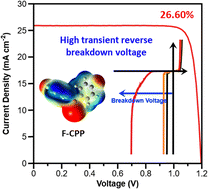
Halogen-induced defects originating from the soft lattices of perovskites are an important factor affecting the quality and stability of perovskite films, especially at buried interfaces. Herein, we propose a dielectric molecular-bridge strategy, which employs bis(4-fluorophenyl)chlorophosphine (F-CPP) to tailor the crystallization of perovskites, inhibit ion migration, regulate the interfacial band arrangement and passivate nonradiative recombination. Interestingly, this strategy can also improve the dielectric constants of perovskites and the reverse-bias stability. The champion device achieves a power conversion efficiency (PCE) of 26.60% with a maximum transient reverse breakdown voltage of −6.6 V, whereas large-area and wide-bandgap devices also exhibit PCEs of 24.08% (1 cm2), 22.56% (1.68 eV), 20.40% (1.73 eV) and 20.19% (1.78 eV). Moreover, under −1 V reverse-bias testing conditions, unencapsulated devices maintain 90.5%, 82.7% and 93.5% of their initial efficiencies after long-term storage, continuous thermal aging, and light soaking, respectively. This work demonstrates a feasible dielectric molecular-bridge strategy for improving the efficiency and stability of perovskite solar cells.
 Please wait while we load your content...


