


 PLATFORM UPDATE:


Methane photolysis to clean hydrogen and carbon nanotubes
 d
Otavio Augusto Titton
Dias,
c
Camilo J.
Viasus Perez,
ae
Jessica
Ye,
ac
Tamlyn
Slocombe,
a
Vijay K.
Tomer,
c
Nhat Truong
Nguyen,
g
Alán
Aspuru-Guzik,
abi
Geoffrey
Ozin
*ab
d
Otavio Augusto Titton
Dias,
c
Camilo J.
Viasus Perez,
ae
Jessica
Ye,
ac
Tamlyn
Slocombe,
a
Vijay K.
Tomer,
c
Nhat Truong
Nguyen,
g
Alán
Aspuru-Guzik,
abi
Geoffrey
Ozin
*ab
Abstract
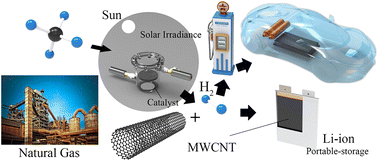
The transition to sustainable hydrogen production is critical to decarbonizing the global energy system and reducing reliance on carbon-intensive methods such as steam methane reforming (SMR). Methane pyrolysis has emerged as a lower-emission alternative, yet its viability is constrained by the extreme temperatures required (600–1200 °C) and associated energy demands. Here, we present methane photolysis, CH4(g) + hv → C(s) + 2H2(g), as a novel, light-driven pathway for simultaneous hydrogen and carbon nanotube production. Operating at ambient conditions and powered by LED illumination, this scalable and continuous process selectively yields clean hydrogen with a maximum hydrogen production rate of 17.74 ± 1.71 mol cm−2 h−1 and high-value carbon nanotubes (CNTs) achieving yields of approximately 8.0 g CNT per g catalyst at a production rate of ∼0.150 ± 0.001 g h−1, while circumventing the thermal and carbon burdens of conventional methods. Compared to water electrolysis, our approach requires approximately 70% less energy per kilogram of H2 produced. For CNTs, the energy savings reach ∼74% relative to conventional methods such as fluidized-bed chemical vapor deposition. Techno-economic and life-cycle assessments demonstrate its potential as a scalable, energy-efficient alternative for decentralized hydrogen and carbon nanomaterial synthesis, with implications for cleaner fuel production and circular carbon utilization.
- This article is part of the themed collection: Recent Open Access Articles
 Please wait while we load your content...


