


 PLATFORM UPDATE:


Phase instability-coupled fracture behavior in garnet LLZO solid electrolytes: a machine learning-enabled atomistic study
 a
Liwen F.
Wan
*a
a
Liwen F.
Wan
*a
Abstract
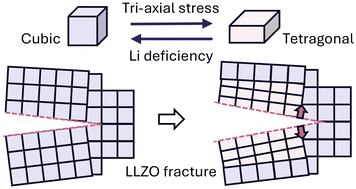
Fracture in the garnet-type solid electrolyte Li7La3Zr2O12 (LLZO) poses a critical threat to both the performance and safety of solid-state batteries. To unravel the coupled chemomechanical processes that govern fracture in LLZO under external loading, we carry out large-scale molecular-dynamics simulations with a validated machine-learning force field. Our results demonstrate that triaxial stresses at crack flanks trigger a localized cubic-to-tetragonal phase transformation, which is accompanied by Li-ion rearrangement. The emergent tetragonal domains feature lattice contraction normal to the fracture plane, imposing coherent misfit strains that provide an additional driving force for further crack propagation. Crucially, introducing Li deficiencies stabilizes the cubic phase, postponing the phase transition and thereby delaying fracture initiation. These findings highlight the role of intrinsic phase instability in dictating LLZO's fracture resistance and its critical connection to local Li concentration. This chemomechanical coupling points toward targeted strategies to enhance the mechanical robustness of garnet electrolytes, including tuning Li content, ensuring dopant homogeneity, and refining processing protocols.
 Please wait while we load your content...


