


 PLATFORM UPDATE:


Substrate-dependent calcium plating on late-transition and p-block metals

Abstract
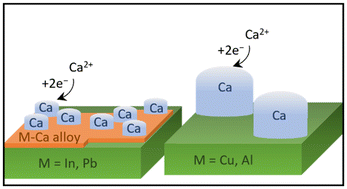
Calcium plating on late-transition and p-block metal substrates was studied in a Ca(BH4)2/THF electrolyte. Electrochemical measurements and post-deposition analysis show clear differences between substrates in both electrochemical response and deposit morphology. On In, Pb and Ga, limited alloy formation is observed at potentials more positive than Ca metal plating. On Cu, Au, Al, and Zn, Ca plating proceeds without observable alloy formation. Short-time galvanostatic experiments reveal differences in the size and spatial distribution of Ca nuclei formed on different substrates. Cycling experiments yield distinct voltage profiles for Pb and In, but these results are discussed separately from the short-time plating experiments.
 Please wait while we load your content...


