


 PLATFORM UPDATE:


High-energy manganese-rich rocksalt cathodes with engineered oxygen vacancies
 a
and
Guoying
Chen
*a
a
and
Guoying
Chen
*a
Abstract
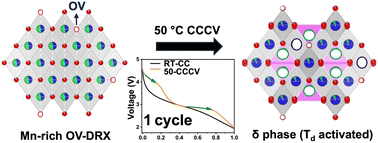
Manganese-rich (Mn > 0.6) disordered rocksalt (DRX) cathodes undergo structural transformation into a spinel-like δ-phase upon cycling, resulting in enhanced energy density and cycling stability. This transformation is a gradual process, often requiring tens of cycles, which presents challenges in their practical implementation. Here, we synthesized a fluorine-containing, d0 transition-metal (TM)-free, Mn-rich DRX with oxygen vacancies (Li1.1Mn0.9O1.8−zF0.2, OV-M90) and investigated the roles of lithium and oxygen non-stoichiometry, redox reactions, and Mn migration in the DRX-to-δ transformation. We found that the tetrahedral site activation, critical for δ-phase formation, is promoted by synergistic interactions among these factors. A CCCV protocol at 50 °C enables rapid δ-phase activation within a single cycle. While d0 TM dopants slow the transformation, they substantially improve the cycling stability. The Ti and Al co-doped Li1.05Mn0.85Ti0.05Al0.05O1.8−zF0.1 (OV-M85T5A5) maintains nearly 100% capacity retention over 100 cycles at 30 mA g−1. These findings provide insights into the DRX-to-δ transformation mechanism and present strategies to overcome the kinetic limitations while improving the cycling stability, paving the way for the development of cost-effective, high-energy cathodes for next-generation lithium-ion batteries.
- This article is part of the themed collection: EES Batteries Recent HOT Articles
 Please wait while we load your content...


