


 PLATFORM UPDATE:


Boron nitride nanotubes for next-generation battery systems
 *a
and
*a
and
Abstract
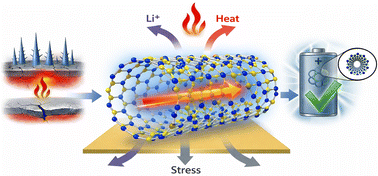
Despite possessing an exceptional combination of electrical insulation, ultrahigh thermal conductivity, and mechanical stiffness, boron nitride nanotubes (BNNTs) have remained largely peripheral to battery research. To date, only a limited number of studies have demonstrated BNNT integration in electrochemical systems, often treating them as passive fillers rather than functional components. Here, we argue that this narrow view obscures the true potential of BNNTs. Owing to their one-dimensional geometry and intrinsically polarized B–N lattice, BNNTs operate as active interfacial regulators capable of directing ion transport, redistributing mechanical stress, and homogenizing thermal gradients. By reframing BNNTs as architectural elements that stabilize electrochemical interfaces under coupled ionic, mechanical, and thermal fields, this work establishes a new design paradigm for robust and safe next-generation energy storage systems.
 Please wait while we load your content...


