


 PLATFORM UPDATE:


Common-ion driven self-assembly of Cu nanoparticles for interfacial stabilization of Zn anodes
 *ab
*ab
Abstract
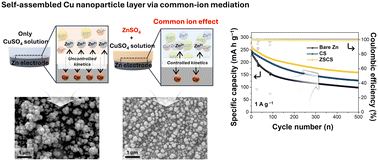
Constructing uniform electrochemically active sites and chemically robust interphases is essential to mitigate the interfacial degradation of Zn anodes in mildly acidic electrolytes. Herein, a self-assembled Cu layer is formed on a Zn electrode via a galvanic replacement reaction driven by the reduction potential difference. Unlike conventional physical coatings, this strategy leverages a common-ion effect to finely regulate redox kinetics and control nanoparticle nucleation and growth behavior, leading to the formation of a conformal and densely packed Cu layer without the need for external energy input. This chemically guided Cu layer effectively modulates the surface energy and Zn2+ ion flux, resulting in preferential Zn nucleation, and suppresses parasitic byproduct formation. Electrochemical analyses reveal that the Cu-coated Zn anodes can improve cycling stability, with symmetric Zn∥Zn cells maintaining stable operation for over 1150 hours and asymmetric Zn∥Cu cells operating for more than 1800 hours at 1 mA cm−2, with high coulombic efficiency. Moreover, the preferential (002) orientation and the in situ formation of a Cu–Zn alloy enable lower nucleation barriers and promote uniform Zn deposition. This synergistic combination of structure and interfacial properties highlights a promising strategy for interfacial regulation in high-performance Zn-based energy storage systems.
 Please wait while we load your content...


