


 PLATFORM UPDATE:


Perinone isomerism effect on proton insertion chemistry
 a
Evgenia
Dmitrieva,
c
Liang
Chen,
a
Mingchao
Wang,
d
Panče
Naumov
*fghi
and
Gang
Wang
*a
a
Evgenia
Dmitrieva,
c
Liang
Chen,
a
Mingchao
Wang,
d
Panče
Naumov
*fghi
and
Gang
Wang
*a
Abstract
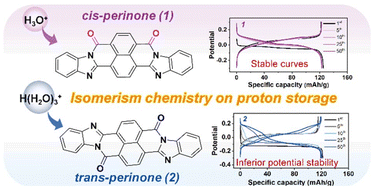
Aqueous proton batteries (APBs) have attracted increasing attention due to their high safety and fast kinetics derived from proton insertion chemistry. Redox-active organic compounds with tunable molecular structures are promising electrode materials for APBs, yet their implementation remains limited by suboptimal cycling stability owing to dissolution of intermediates and structural degradation. Here, we introduce an unexplored concept of exploiting geometric isomerism to tailor structure–property relationships in proton storage. Using highly π-conjugated cis- and trans-perinone isomers as the model system, we reveal that the spatial arrangement of carbonyl groups significantly influences proton insertion processes, overpotential, kinetics, and stability. Proton insertion is confirmed to proceed via a staging mechanism involving both bare and hydrated protons, i.e. H+ and H+·(H2O)n, respectively. Co-insertion of water molecules is comparatively more into the trans-isomer relative to the cis-isomer, resulting in irreversible lattice distortion and inferior potential stability of the former. The cis-isomer delivers exceptional cycling performance with 100% capacity retention after 8000 cycles, exceeding state-of-the-art organic proton-storage materials. This work highlights the crucial role of molecular geometry in dictating electrochemical behavior and offers valuable insights for developing high-performance, practically useful organic rechargeable batteries.
- This article is part of the themed collection: EES Batteries Recent HOT Articles
 Please wait while we load your content...


