Coupling X-ray computed tomography with digital volume correlation to study core collapse in lithium-ion batteries

Abstract

This study investigates the link between internal cell features and mechanical behaviour of commercial cylindrical lithium-ion batteries (LIBs), which impacts both safety and performance. X-ray computed tomography is combined with digital volume correlation to study the core collapse mechanisms of LIBs during cycling. Detailed correlations between volumetric strain distribution and internal mechanical features, such as the positive tab, negative tabs, and kinks, were identified. Complex, heterogeneous swelling takes place within consistent vertical localised bands that correlate with the position of key internal features. The novel data analysis approach also provides insights into the changes in shape of the jellyroll during cycling. The heterogeneous deformation of the cells resulted in wrinkling and buckling of the jellyroll, which was reproduced and correlated to local tensile/compressive strains developing around the innermost layers. This approach can be used to understand the impact of cell design features on core collapse and provide strain data to validate numerical mechanical models.
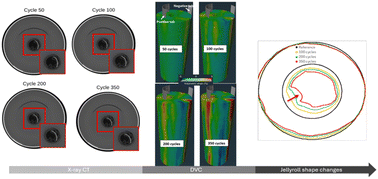
Graphical abstract: Coupling X-ray computed tomography with digital volume correlation to study core collapse in lithium-ion batteries

Supplementary files

Transparent peer review

To support increased transparency, we offer authors the option to publish the peer review history alongside their article.

View this article’s peer review history

Article information

Article type
Paper
Submitted
10 Dec 2025
Accepted
05 Feb 2026
First published
12 Feb 2026
This article is Open Access
Creative Commons BY-NC license

EES Batteries, 2026, Advance Article

Coupling X-ray computed tomography with digital volume correlation to study core collapse in lithium-ion batteries

K. Madi, L. Courtois, L. Raspolini, J. Min, A. Condon and P. M. Attia, EES Batteries, 2026, Advance Article , DOI: 10.1039/D5EB00229J

This article is licensed under a Creative Commons Attribution-NonCommercial 3.0 Unported Licence. You can use material from this article in other publications, without requesting further permission from the RSC, provided that the correct acknowledgement is given and it is not used for commercial purposes.

To request permission to reproduce material from this article in a commercial publication, please go to the Copyright Clearance Center request page.

If you are an author contributing to an RSC publication, you do not need to request permission provided correct acknowledgement is given.

If you are the author of this article, you do not need to request permission to reproduce figures and diagrams provided correct acknowledgement is given. If you want to reproduce the whole article in a third-party commercial publication (excluding your thesis/dissertation for which permission is not required) please go to the Copyright Clearance Center request page.

Read more about how to correctly acknowledge RSC content.

Social activity

Spotlight

Advertisements