Vertically orientated one-dimensional titania lepidocrocite quasi nanoflakes for stabilized lithium deposition in lithium metal anodes

Abstract

Lithium metal has long been considered the ideal anode for a variety of cell chemistries owing to its quite high gravimetric capacity. Dendrite growth, loss of Li in SEI, and processing challenges, however, restrict its practical deployment. Here, a new form of titania, TiO2, viz. 1-dimensional lepidocrocite (1DL) are used as the basis for creating a Li scaffold. The basic units are Ti–O chains – 5 × 7 Å2 in cross-section – that can assemble into quasi 2D nanoflakes. These nanoflakes are synthesized via a bottom-up reaction, directly from commercial 3D-bulk solids at near ambient temperatures and pressures. Here the 2D flakes are vertically oriented to guide Li-metal deposition and serve as a Li metal scaffold. This is achieved through a directional control freezing of an aqueous blade cast slurry. The vertical-1DLs (V-1DL) enable Li nucleation at lower overpotentials compared with bare copper or a conventional cast slurry of 1DL. Their long-range order and vertical alignment contribute to improved Li-ion fluxes. V-1DLs also show improved cyclability with plating and stripping at 2 mAh cm−2 and 2 mA cm−2, up to 150 h. Dead Li measurements further indicate that V-1DL reduces Li loss to dead Li.
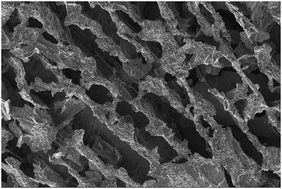
Graphical abstract: Vertically orientated one-dimensional titania lepidocrocite quasi nanoflakes for stabilized lithium deposition in lithium metal anodes

Supplementary files

Article information

Article type
Paper
Submitted
12 Oct 2025
Accepted
06 Feb 2026
First published
07 Feb 2026
This article is Open Access
Creative Commons BY-NC license

EES Batteries, 2026, Advance Article

Vertically orientated one-dimensional titania lepidocrocite quasi nanoflakes for stabilized lithium deposition in lithium metal anodes

N. A. Cardoza, M. Qin. Hassig, T. Ngo, T. Yim, B. Markunas, J. Snyder, M. W. Barsoum and V. Kalra, EES Batteries, 2026, Advance Article , DOI: 10.1039/D5EB00196J

This article is licensed under a Creative Commons Attribution-NonCommercial 3.0 Unported Licence. You can use material from this article in other publications, without requesting further permission from the RSC, provided that the correct acknowledgement is given and it is not used for commercial purposes.

To request permission to reproduce material from this article in a commercial publication, please go to the Copyright Clearance Center request page.

If you are an author contributing to an RSC publication, you do not need to request permission provided correct acknowledgement is given.

If you are the author of this article, you do not need to request permission to reproduce figures and diagrams provided correct acknowledgement is given. If you want to reproduce the whole article in a third-party commercial publication (excluding your thesis/dissertation for which permission is not required) please go to the Copyright Clearance Center request page.

Read more about how to correctly acknowledge RSC content.

Social activity

Spotlight

Advertisements