


 PLATFORM UPDATE:


Resolving the true origin of mossy morphology in aqueous Zn batteries
 *ab
*ab
Abstract
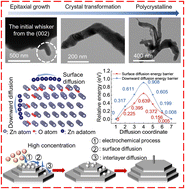
Aqueous zinc-based batteries hold great potential for next-generation energy storage because of their high safety, low cost, and promising electrochemical performance. However, uneven Zn deposition during charging poses a major challenge to their cycling stability. Although dendritic growth has been extensively studied as a typical form of uneven deposition, the evolution and formation mechanism of mossy Zn morphology has remained unclear for a long time. In this work, we move beyond the conventional view that nucleation governs Zn morphology and propose a new mechanism that the interlayer diffusion of adsorbed Zn atoms is the rate-determining step responsible for mossy deposition. This perspective explains why such a morphology tends to form under low polarization and high electrolyte concentrations. Furthermore, although pulse current effectively suppresses dendrites by mitigating ion depletion, the resulting electrolyte enrichment contradicts the suppression of mossy growth. Here, a new explanation for the pulse-induced suppression of mossy zinc morphology is also proposed. Finally, we demonstrate that adding a small amount of potassium stannate (K2SnO3) to the electrolyte accelerates interlayer diffusion and eliminates mossy deposition even under low polarization and high capacity, offering new insights for optimizing Zn anodes in future battery designs.
 Please wait while we load your content...


