


 PLATFORM UPDATE:


Initial characterization and cycling of two batches of commercial hard-carbon/NaxNiyFezMn1−y−zO2 sodium ion 18650 batteries as a potential replacement for lithium-ion batteries

Abstract
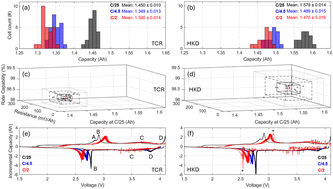
This work presents a comparative analysis of two initial release commercial sodium-ion 18650 cells manufactured by Tycorun and Hakadi with identical layered oxide (NaNi1/3Fe1/3Mn1/3O2) cathodes and hard carbon anodes. Through electrochemical benchmarking and advanced materials characterization, this study evaluated cell-to-cell variability, interfacial chemistry, and early-life degradation pathways. Both batches demonstrated manufacturing consistency analogous to lithium-ion standards but differences in binder type and electrolyte formulation which induced distinct solid electrolyte interphase characteristics. Overall, capacity retention fell significantly short of manufacturer specifications, with observable failure modes in Hakadi cells linked to a wider operating voltage window. These findings underscore the need for standardization in manufactured components, operating parameters, and in initial cell testing to evaluate performance.
 Please wait while we load your content...


