


 PLATFORM UPDATE:


Several concerns about aqueous zinc metal batteries: from components to unit cells
 ab
and
Guozhao
Fang
*ab
ab
and
Guozhao
Fang
*ab
Abstract
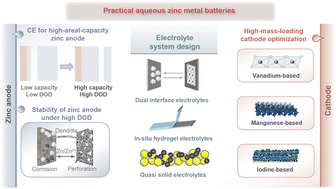
Aqueous zinc metal batteries (AZMBs) remain highly promising for clean and safe large-scale energy storage. Currently, the pursuit of single performance indicators in laboratory research is often based on low-areal-capacity anodes, low-mass-loading cathodes, and excess electrolytes, which is insufficient to satisfy the stringent requirements of practical applications. There are also significant challenges in some promising strategies and performance evaluation models. This review highlights the key issues from electrodes and electrolytes to unit cells of AZMBs. Typical strategies for the high areal capacity and large-capacity batteries are systematically analyzed from the perspectives of the anode, cathode, and electrolyte components. Furthermore, the differences between laboratory and industrial batteries are discussed in terms of critical indicators such as energy density, energy efficiency, and self-discharge performance. Finally, critical perspectives are proposed for achieving large-capacity AZMBs, offering scientific value for their practical development.
- This article is part of the themed collection: EES Batteries 2026 Review Articles
 Please wait while we load your content...


