


 PLATFORM UPDATE:


Synergistic effect between carbon-confined bismuth nanoparticles and K+-ether co-intercalation enables high-rate potassium storage at −50 °C
 ab
and
Li
Zhang
*ac
ab
and
Li
Zhang
*ac
Abstract
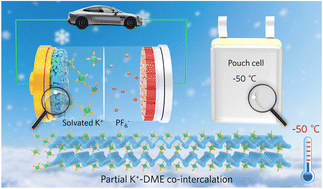
The sluggish desolvation kinetics of K+ cations is widely recognized as a major bottleneck limiting the electrochemical performance of potassium ion batteries (PIBs) at low temperatures (LTs). Recent studies have identified the Li+/Na+-solvent co-intercalation mechanism is an effective strategy to lower desolvation energy and enhance low-temperature electrochemistry, yet its implementation remains rarely unexplored in PIBs, particularly below −40 °C. Meanwhile, the rational design of electrode structures is also crucial for achieving effective K+-solvent co-intercalation. Herein, we propose a rationally engineered architecture in which bismuth nanoparticles (∼19 nm) are uniformly confined within a conductive carbon framework (Bi@CFs). Experimental and theoretical analyses collectively reveal that the Bi@CFs configuration facilitates K+-ether co-intercalation, thereby lowering the desolvation energy barrier and achieving high-capacity and high-rate potassium storage at −50 °C. Accordingly, the Bi@CFs half-cell stably cycles over 400 cycles at −50 °C and 1 A g−1, maintaining an ultrahigh reversible capacity of 345.61 mAh g−1 with negligible degradation. Paired with an activated carbon (AC) cathode, the Bi@CFs/AC full cell presents an impressive energy density of 121.66 Wh kg−1 and power density of 9658.28 W kg−1 at −50 °C, along with an ultra-long lifespan exceeding 10 000 cycles. This work lays the foundation for high-performance PIBs capable of stable operation at extremely low temperatures.
- This article is part of the themed collection: EES Batteries Recent HOT Articles
 Please wait while we load your content...


