


 PLATFORM UPDATE:


Mn3O4 and its hybrids as anode active materials for lithium-ion batteries: a review
 ab
Peter C.
Sherrell,
ac
Andrew
Thomas,
bd
Aravind
Vijayaraghavan
be
and
Amanda V.
Ellis
*a
ab
Peter C.
Sherrell,
ac
Andrew
Thomas,
bd
Aravind
Vijayaraghavan
be
and
Amanda V.
Ellis
*a
Abstract
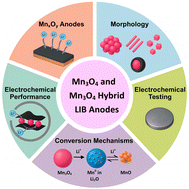
Developing new anode materials for lithium-ion batteries (LIBs) is of great interest to meet the rising global energy demand and requirements for electric vehicles (EVs). Manganese oxides (MnXOY) have high abundance, high theoretical specific capacities and are low in cost. This critical review provides a comprehensive literature review of MnXOY anodes, with particular emphasis on Mn3O4 and Mn3O4 hybrid materials. The evolution of the LIB is introduced, followed by problems with graphite anodes. MnXOY materials are discussed and the electrochemical testing, morphology and electrochemical performance of Mn3O4 and Mn3O4 hybrid anodes are compared in detail. Special attention has been paid to MnXOY/rGO anodes, examining synthesis methods, electrochemical properties, conversion mechanisms and ion diffusion rates. The future outlook and challenges in this field are also evaluated.
- This article is part of the themed collection: EES Batteries 2026 Review Articles
 Please wait while we load your content...


