


 PLATFORM UPDATE:


Pre-existing particle composition controls the initial viscosity and aging of α-pinene-derived secondary organic aerosol
 a
Natasha M.
Garner,
*bc
David M.
Bell,
b
Jens
Top,
b
Markus
Ammann
b
and
Andrew P.
Ault
*a
a
Natasha M.
Garner,
*bc
David M.
Bell,
b
Jens
Top,
b
Markus
Ammann
b
and
Andrew P.
Ault
*a
Abstract
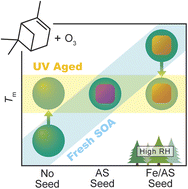
Secondary organic aerosol (SOA) is a significant contributor to the global burden of fine particulate matter, which impacts both climate and health. α-Pinene is a widely-studied volatile organic compound (VOC) with high global emissions and SOA-forming potential. However, the vast majority of SOA forms on preexisting particles whose composition leads to different molecular species and physical properties. Understanding the viscosity of SOA-containing particles is critical to predicting their atmospheric behavior, as it influences heterogeneous chemistry, particle growth, and particle aging. The viscosity of SOA can range over many orders of magnitude from liquid (<102 Pa s) to viscous to glassy (>1012 Pa s). Nanothermal analysis (NanoTA) measures single particle melting temperatures (Tm) for submicron particles, which can be converted to glass transition temperatures (Tg), viscosities, and, ultimately, mixing time scales. In this study, we directly measured the Tm of α-pinene SOA formed with no seeds, ammonium sulfate seeds, and Fe-containing ammonium sulfate seeds, both before and after UV exposure. We compare these to modeled viscosities based on chemical composition measurements of the bulk aerosol. The median viscosity of measured particles was 1–3 orders of magnitude more viscous than predicted by existing models for all conditions except those of freshly-emitted, unseeded SOA. After UV exposure, the Tm values for all seed conditions converged, indicating that aged SOA viscosity was less dependent on the initial seed. These results indicate the importance of pre-existing seed particles for initial SOA viscosity and that this viscosity evolves during a particle's atmospheric lifetime.
 Please wait while we load your content...


