


 PLATFORM UPDATE:


Toward reliable air quality simulations over India: optimizing WRF-Chem through comprehensive sensitivity analysis of meteorology, physical parameterizations, and emission inventories
 *a
and
Dilip
Ganguly
a
*a
and
Dilip
Ganguly
a
Abstract
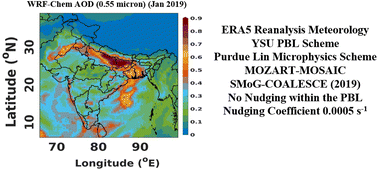
Air pollution in India remains a severe environmental and public health challenge, intensified by meteorological conditions, particularly during winter and the post-monsoon season. This study conducts a systematic, multi-component sensitivity evaluation of the Weather Research and Forecasting model coupled with Chemistry (WRF-Chem) to identify an optimal configuration for simulating air quality over India. We assess the influence of meteorological initial and boundary conditions, physical and chemical parameterization schemes, emission inventories, and grid-nudging strengths through simulations for two contrasting periods, the monsoon season (August 2018) and winter (January 2019). Model performance is strongly configuration dependent, with ECMWF Reanalysis 5th Generation (ERA5) meteorology substantially improving the representation of surface temperature, relative humidity, wind speed, and vertical thermodynamic structure. Incorporating moderate grid nudging (0.0005 s−1) reduced relative humidity biases by 13% during January 2019 and improved temperature inversion strength and planetary boundary layer (PBL) representation. The Yonsei University PBL (YSU) and Lin microphysics schemes produced the most realistic PBL heights, rainfall fields, and wet-deposition-driven pollutant removal. For atmospheric composition, the Model for Ozone And Related chemical Tracers coupled with Model for Simulating Aerosol Interactions and Chemistry (MOZART-MOSAIC) mechanism, combined with the high-resolution Speciated Multi-pollutant Generator – Coordinated Aerosol and Pollution Source Emissions for Chemical Evaluation (SMoG-COALESCE) emission inventory, yielded the most accurate simulations of PM2.5, SO2, O3, and CO across urban and rural regions. The integrated optimal configuration improved model skill relative to Central Pollution Control Board (CPCB) surface measurements, reanalysis products, and satellite datasets. These results demonstrate the need for coordinated evaluation of meteorological and chemical components in WRF-Chem and provide a robust modelling framework for improving air-quality prediction and supporting policy-relevant assessments of pollution mitigation strategies over India.
 Please wait while we load your content...


