


 PLATFORM UPDATE:


Estimating rate coefficients for the reactions of ethers + OH from atmospheric to combustion temperatures: an extension of the electrotopological state method

Abstract
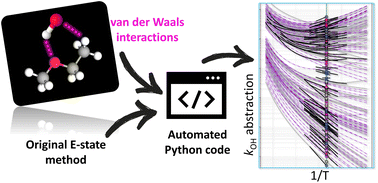
The reactions of ethers with OH present a challenge to estimation techniques. These hydrogen abstraction reactions exhibit both positive and negative temperature dependences according to temperature regime and degree of halogenation. Positive temperature dependence relates to reactants overcoming energy barriers in the primary process of hydrogen abstraction, and is readily described using a recently developed structure–activity relationship based upon the electrotopological state (E-state). Conversely, we attribute the negative temperature dependence to the formation of van der Waals (vdW) pre-reactive complexes that facilitate reactions through quantum tunnelling, for which we have developed a simple parameterization. This is implemented in the current version of the E-state code in a modular fashion, leaving the original parameterization for alkanes and haloalkanes unmodified. We find that this treatment combined with the a priori information provided by the E-state affords, to some extent, the decoupling of these opposing behaviours leading to a robust prediction of temperature-dependent rate coefficients with OH, k(T), compared with existing methodologies. This approach, named E-stateXvdW, provides site-specific, temperature-dependent estimates implemented in a freely available open-source Python programme that can estimate large batches of compounds automatically and at negligible computational cost over a broad temperature range (∼190–1500 K). This method applies to all acyclic non-halogenated and halogenated ethers of composition CnO≤n−1HmX2n+2−m, and provisionally, all cyclic ethers of composition CnO≤n−1HmX2n−m, where X represents any combination of F, Cl, Br and I, n = [1, 2, …] and m = [1, 2, …, 2n + 2]. This approach may be useful to modellers and environmental scientists who wish to assess the fate of industrially important etheric molecules, as well as those chemists with an interest in rationalizing the reactivity of molecules based on their structural characteristics.
- This article is part of the themed collection: The influence of combustion emissions on air quality and atmospheric processes
 Please wait while we load your content...


