


 PLATFORM UPDATE:


Oxidation of organic films at the mineral–water interface by aqueous-phase ozone affects aerosol light scattering
 ab
Rebecca J. L.
Welbourn,
bc
Tobias W. D.
Robson,
ad
Philipp
Gutfreund,
e
Katherine C.
Thompson,
f
Adrian R.
Rennie
g
and
Martin D.
King
*a
ab
Rebecca J. L.
Welbourn,
bc
Tobias W. D.
Robson,
ad
Philipp
Gutfreund,
e
Katherine C.
Thompson,
f
Adrian R.
Rennie
g
and
Martin D.
King
*a
Abstract
Interfacial organic films on atmospheric aerosol particulates can modify their light scattering properties, potentially impacting Earth's radiative balance. Here, a proxy for organic films at the aerosol mineral–water interface is measured using neutron reflectometry, and the results are contextualized in a single particle light scattering model, N-Mie. Model lipid-bilayers, composed of DPPC (no double bonds), POPC (1 carbon–carbon double bond), and DOPC (2 carbon–carbon double bonds), were deposited on a silica–water interface and oxidized with aqueous ozone to simulate the oxidation of organic films on aqueous mineral aerosol particles. Neutron reflectometry measurements showed that these bilayers initially formed films approximately 4 nm thick, and oxidation by aqueous ozone led to thickness reductions proportional to the number of carbon–carbon double bonds. Post-oxidation thicknesses were 4 nm (DPPC), 1.6 nm (POPC), and 0.4 nm (DOPC). Light scattering modelling of particulates with a mineral core and water film revealed that a 1 nm lipid-like organic film at the mineral–water interface had similar effects on the single scattering albedo (ω) asymmetry parameter (g), and forcing efficiency  of an aerosol particulate as at the air–water interface. The Mie modelling also revealed that an increase in the thickness of the organic film at the mineral–water interface of up to 10 nm results in an increase in forward scattering of light (Δg = 0.025), a decrease in the amount of light scattered (Δω = −0.016) and an aerosol forcing efficiency
 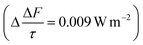 . The findings presented here indicate that organic films with experimentally measured thicknesses at the mineral–water interface can significantly alter aerosol forcing efficiency.

 Please wait while we load your content...


