


 PLATFORM UPDATE:


The effect of surface sink saturation and emission altitude on hydrogen's atmospheric impact

Abstract
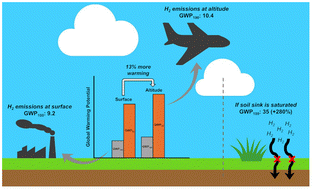
Hydrogen is often viewed as a potential component of a decarbonized transportation system, offering the ability to eliminate direct CO2 emissions while being produced with low lifecycle greenhouse gas emissions. However, direct emissions of hydrogen can trigger indirect climate and air quality effects which may partially or fully offset these benefits. We use the GEOS-Chem High Performance (GCHP) global chemistry-transport model to investigate how surface sink representation and emission altitude influence the climate impact of hydrogen emissions, specifically with respect to high-altitude emissions from prospective future hydrogen aircraft. We show that if the soil sink becomes saturated and can no longer increase uptake rates as atmospheric hydrogen concentrations rise, the perturbation lifetime of hydrogen increases, leading to a 3.8-fold increase in hydrogen's climate impact over 100 years compared to an unsaturated sink. We demonstrate that if the soil sink is unsaturated, hydrogen emitted at commercial aircraft cruise altitudes (∼11 km) has a greater climate impact than equivalent surface emissions. The magnitude of this additional impact varies between 8% over a 20-year horizon to 13% over 100 years. This altitude sensitivity results from the vertical separation between high-altitude hydrogen emissions and the soil sink, which increases the likelihood of removal by OH. Our findings highlight the need to prioritize mitigation of high-altitude hydrogen emissions, such as those from potential future hydrogen-fueled aircraft, compared to surface hydrogen emissions. More broadly, they reveal the limitations of fixed-boundary condition models to capture these mechanisms, underscoring the importance of transitioning to surface sink representations that can capture dynamic soil uptake responses. Constraining the real-world behavior of the soil sink remains a key research priority for accurately assessing hydrogen's climate impacts.
 Please wait while we load your content...


