


 PLATFORM UPDATE:


Modeling secondary organic aerosols from β-caryophyllene: role of extremely low-volatile organic compounds on new particle formation and evaluation of the SOA composition
 *ab
Karine
Sartelet
b
*ab
Karine
Sartelet
b
Abstract
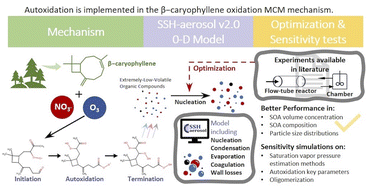
β-Caryophyllene (BCARY), a prevalent biogenic sesquiterpene, is an important precursor of secondary organic aerosol (SOA). While extremely low-volatility organic compounds (ELVOCs) formation by autoxidation may be critical to accurately represent SOA formation, current mechanisms omit this process. To address this missing process, we developed the autoX-MCM mechanism as an extension of the Master Chemical Mechanism v3.3.1 by incorporating a semi-explicit peroxy radical autoxidation for BCARY ozonolysis and oxidation by the nitrate radical  . The mechanism was constrained against a suite of literature experiments conducted in both flow-tube and chamber reactors. Simulation using SSH-aerosol with autoX-MCM successfully reproduced ELVOC yields, SOA mass loading, and new particle formation reported by several experimental studies at different temperatures (from 273 K to 313 K). The developed mechanism also simulated accurately SOA composition, including β-caryophyllinic acid yields, the amount of oligomers, and the amount of SOA containing a nitrate group. Our results indicate that including autoxidation in the BCARY oxidation mechanism is essential to accurately reproduce SOA formation, especially at 298 K, the model reproduced SOA concentrations with a mean bias of 0.05 µg m−3 and a normalized RMSE of 3.89% compared with experimental observation.
 Please wait while we load your content...


