


 PLATFORM UPDATE:


Pollution status, source apportionment, and environmental risk assessment of trace metals in the atmospheric particulates of Islamabad, Pakistan

Abstract
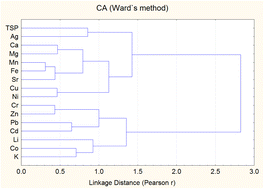
This study evaluates the pollution status, source apportionment, and potential health and environmental risks of atmospheric particulates and the trace metals associated with them. Particulates were sampled on glass fibre filters in Islamabad's typical urban areas. Atomic absorption spectroscopy was employed to quantify the trace metals. Among the trace metals, Ca (3906 ng m−3) had the highest concentration, while Ag (3.515 ng m−3) showed the lowest concentration. The overall mean levels of the metals were in the ascending order of Ag < Li < Cd < Co < Cu < Mn < Cr < Sr < Zn < Pb < Fe < Mg < K < Ni < Ca. Particulate emission sources were identified using the multivariate PCA and CA, and it was revealed that the major pollution sources were fossil fuel combustion, local industries, road dust, and automobile emissions. The enrichment factor (EF) and the geoaccumulation index (Igeo) were used to determine the contamination level. All metals exhibited EF values greater than unity (>1.0), indicating that they predominantly originated from anthropogenic sources, except for Fe. The ecological risk assessment revealed that Ni showed the highest environmental risk (Er > 320) among the toxic trace metals. Similarly, the cancer risk (CR) assessment showed that the computed value for Ni was exceptionally higher than the safe limits (>1 × 10⁻⁴), revealing an increased cancer risk for the local population. Likewise, Cr, Co, and Cd exposure were linked to significant cancer risk (>1 × 10⁻⁶), while Pb exposure posed an insignificant cancer threat (<1 × 10⁻⁶). The current metal concentrations in the particulates were also compared with those observed globally. Overall, the study revealed predominant anthropogenic contamination and significant health risks associated with the trace metals in atmospheric particulates.
 Please wait while we load your content...


