


 PLATFORM UPDATE:


Chemical signatures of water-soluble organic carbon (WSOC) fraction of long-range transported wildfire PM2.5 from Canada to the United States Mid-Atlantic region
 a
Martin Changman
Ahn,
b
Dewansh
Rastogi,
b
Yue
Li,
a
Candice M.
Duncan
c
and
Akua
Asa-Awuku
*abd
a
Martin Changman
Ahn,
b
Dewansh
Rastogi,
b
Yue
Li,
a
Candice M.
Duncan
c
and
Akua
Asa-Awuku
*abd
Abstract
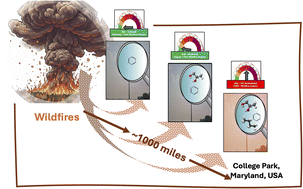
Smoke from the Canadian wildfires in the summer of 2023 spread over seventeen million hectares, traveled across the North American continent, and air quality alerts were issued in 20 states in the United States. Its effects were visible in the Northeast and Mid-Atlantic East Coast regions as the air quality index (AQI) increased to very unhealthy levels. For this work, Particulate Matter (PM) samples were collected during the peak of the pollution event in College Park, Maryland, located more than 1000 miles from the source of the fires. Thus, results of this work provide insights into the molecular-level composition of long-range transported wildfire emissions. Specifically, a non-targeted chemical analysis of aerosols collected during and after the wildfire season is presented. The chemical composition of the water-soluble organic carbon (WSOC) compounds is determined using a Bruker Maxis-II Q-TOF mass spectrometer coupled with a Waters Acquity I-Class PLUS LC system. The results reveal a substantial presence of oxy-hydrocarbons (CHO) and nitrated oxy-hydrocarbons (CHON). Additional compound groups were also detected, incorporating elements such as sulfur, phosphorus, silicon, and various halogens, with chain lengths ranging from C3 to C41. Our results highlight the prominence of aged water-soluble organic compounds (with O/C ratio ranging from 0.2–0.7) from long-range transported wildfire.
 Please wait while we load your content...


