


 PLATFORM UPDATE:


Acetyl peroxy radical-initiated oxidation of oxygenated monoterpenes: functional group effects on reaction pathways
 a
Nanna
Myllys
*ab
a
Nanna
Myllys
*ab
Abstract
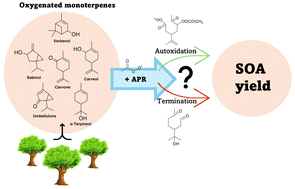
Biogenic volatile organic compounds are emitted into the atmosphere where they can oxidize forming compounds with lower volatilities. These low-volatility compounds can participate in the formation of secondary organic aerosols (SOAs) that affect human health and the climate in various ways. We studied the oxidation pathways initiated by the acetyl peroxy radical (APR) of less frequently studied oxygenated monoterpenes (monoterpenoids) using computational methods. The studied reactions included APR-addition, ring-opening reactions and C–C bond scissions. Ring-rearrangement after APR-addition was shown to be significant (43% yield) for one bicyclic monoterpenoid, sabinol. All other studied monoterpenoids will mostly react only with O2 forming a peroxy radical which will go on to form an alkoxy radical. Alkoxy radical β-scissions lead to different kinds of products depending on the reacting monoterpenoid. Verbenol and α-terpineol will mostly form closed-shell species through alkoxy radical C–C bond scissions leading to low SOA yields. The fate of carveol depends strongly on the stereoisomer. The S-isomer will form a closed-shell species with a 50% yield, whereas the R-isomer will form an alkyl radical with a 100% yield capable of further oxidation. Therefore, a significant SOA yield could be expected for carveol depending on the stereoisomer. For sabinol, umbellulone and carvone, high SOA yields are expected as the majority of them will form an alkyl radical that reacts with O2 forming a new peroxy radical. In the case of umbellulone and carvone, the formed peroxy radical is an acyl peroxy radical which can undergo rapid unimolecular reactions initiating fast autoxidation. Compared to the monoterpene counterparts of the studied monoterpenoids, significant differences were observed in reaction pathways and SOA yields. While APR-initiated oxidation serves as a minor pathway in the atmosphere, the studied reactions could have an impact on the production of low-volatility compounds.
 Please wait while we load your content...


