


 PLATFORM UPDATE:


Emissions of volatile organic compounds from industrial sources and their effects on ozone formation in Wuhan, China
 *a
Yong
Liang
a
*a
Yong
Liang
a
Abstract
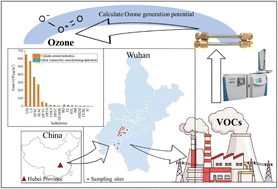
Emissions of typical forty-eight volatile organic compounds (VOCs) were investigated inside sixteen industries, including the vehicle-related industries and commodity manufacturing industries located in Wuhan, China. The total concentrations of the twenty-seven detectable VOCs ranged from 0.4 to 99.8 µg m−3, with vehicle-related industries (1.3–99.8 µg m−3) emitting more VOCs than the commodity manufacturing industry (0.4–20.0 µg m−3). Data comparison between organized and fugitive emission groups revealed that the VOCs emitted from organized vehicle-related industries implementing the zeolite rotary concentrator system coupled with the regenerative thermal oxidizer catalytic combustion technology (0.04–31.5 µg m−3) could significantly meet the national emission standards (500–40000 µg m−3). This technology was proven to have a remarkable effect on reducing benzene-based VOCs, which are important precursors of ozone (O3). A significant decreasing trend of O3 levels was observed with the increase in the distance around these vehicle-related industries based on the data from the monitoring and control platform of small air quality monitoring stations of Wuhan. The total O3 formation potential (OFP) values calculated based on these twenty-seven VOCs in the vehicle-related industries were 5.3–646.8 µg m−3, in which aromatic hydrocarbons were the most reactive analogues, with a cumulative share of 93.0% of the O3 formation potential. 1,3,5-Trimethylbenzene and o-xylene, which together account for 52.3% of the total OFP values, should be identified as the priority pollutants to be controlled in the vehicle-related industry. This study emphasizes the contribution of VOCs emitted from vehicle-related industries to ozone pollution and further provides ideas for prioritizing industrial VOCs for improving regional O3 control strategies.
- This article is part of the themed collection: The influence of combustion emissions on air quality and atmospheric processes
 Please wait while we load your content...


