Adsorption, catalytic oxidation, and phytoremediation for air pollution control: a comprehensive review

Abstract

Modern office infrastructure, furnishings, and traditional cooking practices contribute to air pollution, posing significant health risks, including respiratory issues, cancer, and immune system suppression, especially for vulnerable groups. This review examines recent progress in adsorption, catalytic oxidation, and phytoremediation for reducing volatile organic compounds and fine particulate matter, major air pollutants. Adsorption technologies employ conventional materials like activated carbon and advanced options like metal–organic frameworks and biochars, offering high adsorption capacities due to tunable structures and large surface areas. Catalytic oxidation, including photocatalytic and thermocatalytic methods, effectively degrades pollutants, with composites like nano-ZnO/coke enhancing removal efficiencies. Phytoremediation using household plants like Epipremnum aureum and green walls effectively removes pollutants through enzymatic degradation, stomatal absorption, and microbial synergy. This review assesses integrated strategies' scalability, efficiency, and practicality for comprehensive air quality management, highlighting their potential to enhance public health.
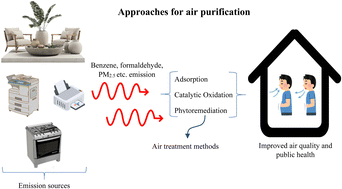
Graphical abstract: Adsorption, catalytic oxidation, and phytoremediation for air pollution control: a comprehensive review

Transparent peer review

To support increased transparency, we offer authors the option to publish the peer review history alongside their article.

View this article’s peer review history

Article information

Article type
Critical Review
Submitted
10 Jul 2025
Accepted
13 Nov 2025
First published
25 Nov 2025
This article is Open Access
Creative Commons BY-NC license

Environ. Sci.: Atmos., 2026, Advance Article

Adsorption, catalytic oxidation, and phytoremediation for air pollution control: a comprehensive review

A. Talaie, M. A. Fulazzaky, S. Rezania and A. Tamadon, Environ. Sci.: Atmos., 2026, Advance Article , DOI: 10.1039/D5EA00079C

This article is licensed under a Creative Commons Attribution-NonCommercial 3.0 Unported Licence. You can use material from this article in other publications, without requesting further permission from the RSC, provided that the correct acknowledgement is given and it is not used for commercial purposes.

To request permission to reproduce material from this article in a commercial publication, please go to the Copyright Clearance Center request page.

If you are an author contributing to an RSC publication, you do not need to request permission provided correct acknowledgement is given.

If you are the author of this article, you do not need to request permission to reproduce figures and diagrams provided correct acknowledgement is given. If you want to reproduce the whole article in a third-party commercial publication (excluding your thesis/dissertation for which permission is not required) please go to the Copyright Clearance Center request page.

Read more about how to correctly acknowledge RSC content.

Social activity

Spotlight

Advertisements