


 PLATFORM UPDATE:


Synthesis and characterization of honeycomb-like carboxylate-bridged dimeric Cu(ii) and Zn(ii)-based coordination polymers with a pyridyl Schiff base linker: dye sorption and Schottky device applications

Abstract
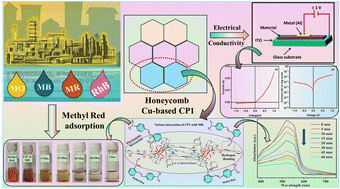
The coordination polymers (CPs)/metal–organic frameworks (MOFs) incorporating hetero-bridging ligands have remarkable efficiency and versatility towards fulfilling the objectives of the Sustainable Development Goals (SDGs). In this aspect, two CPs, [Cu2(3-bph)2(adc)4]n (CP1) and [Zn2(3-bph)2(adc)4]n (CP2) (3-bph = (1E,2E)-1,2-bis(pyridin-3-ylmethylene)hydrazine and adc− = 1-adamantanecarboxylate), are characterised, and their significant semiconducting property and selective dye sorption activity are explored. The CPs comprise a secondary building unit (SBU) of a carboxylate-bridging adc− paddle-wheel, [M2(adc)4] (M = Cu(II), Zn(II)), which undergoes pyridyl-N linking by 3-bph to form a 1D chain, where the pyridyl rings undergo π–π interaction to construct a 2D honeycomb-supramolecular network. Interestingly, CP1 demonstrates the selective sorption of methyl red (MR) dye out of four dyes (methylene blue, rhodamine B, methyl red, and methyl orange) with a removal efficiency of 95.37% from aqueous solution within 1 h, whereas CP2 does not show measurable sorption activity. The sorption of CP1 fits the Langmuir isotherm (R2 = 0.9875) and follows pseudo-second-order kinetics, indicating chemisorption on a heterogeneous surface. The DFT calculations using crystallographic parameters determined the band gaps in the semiconducting region (2.39 eV (cal.) and 3.68 eV (exp.) for CP1 and 2.32 eV (cal.) and 3.65 eV (exp.) for CP2). This inspired the measurement of the electrical conductivity from a fabricated Schottky device with thin film electrodes, ITO/CPs/Al. The experiments show that CP2 (5.27 × 10⁻³ S m−1) has higher electrical conductivity than CP1 (2.72 × 10⁻³ S m−1) under identical conditions, which explains the superior charge-transport features of CP2 in comparison with CP1. These findings highlight that CP1 serves as a promising material for application as a sustainable MR dye removal agent from wastewater, while both CP1 and CP2 are potential candidates for semiconducting applications.
 Please wait while we load your content...


