


 PLATFORM UPDATE:


Iridium(iii) polypyridyl and cyclometalated complexes for DNA targeting, bioimaging, and light-activated therapeutics: recent progress, mechanistic insights, and emerging design strategies—a mini review
 *a
and
Jim A.
Thomas
*a
*a
and
Jim A.
Thomas
*a
Abstract
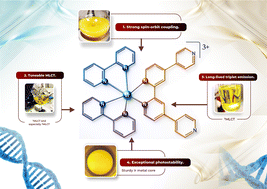
Iridium(III) polypyridyl and cyclometalated complexes have emerged as highly versatile coordination compounds with applications spanning photocatalysis, optoelectronics, bioimaging, and photodynamic therapy. Whilst ruthenium(II) polypyridyl complexes have historically dominated nucleic acid recognition studies, iridium(III) systems possess distinct physicochemical advantages arising from strong spin–orbit coupling, tuneable metal-to-ligand charge-transfer (MLCT) states, long-lived triplet emission, and exceptional photostability. Despite these favourable features, their development as DNA-targeting agents remains comparatively underexplored, and mechanistic understanding lags behind that of ruthenium(II) counterparts. This review provides a structured overview of the recent advances in Ir(III) polypyridyl and cyclometalated complexes for DNA binding, luminescent sensing, and light-activated cytotoxicity. Particular emphasis is placed on structure–activity relationships, excited-state processes governing DNA-responsive luminescence, and photocleavage mechanisms. Comparisons with ruthenium(II) systems are drawn throughout to highlight iridium-specific design logic. Finally, current challenges and future research directions are identified to guide the rational development of multifunctional iridium(III) complexes for medicinal inorganic chemistry and therapeutic applications.
 Please wait while we load your content...


