


 PLATFORM UPDATE:


Synthesis of silver nanoparticles and their attachment to a zinc oxide–iron oxide hybrid structure: analyte-mediated enhanced peroxidase-like activity for colorimetric detection

Abstract
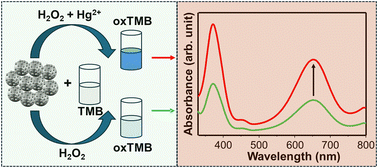
Natural and human activities, such as mining for gold, coal-fired power stations, coal burning, and different industrial processes, have contributed to the emission of mercury into the environment. This necessitates regular monitoring of mercury in the environment. The requirement of skilled personnel, high costs, and time-consuming processes make the conventional techniques used in the detection of mercury unsuitable for routine analysis. Colorimetric methods overcome these limitations. In this study, silver nanoparticle (AgNP)-loaded ZnO/Fe3O4 (ZMN) composites (AgZMN) with peroxidase-like activity are produced. Ferrous sulphate is used to reduce Ag+ to Ag0 because of the difference in the reduction potentials of the two reacting species. Surface-enhanced Raman spectroscopy (SERS) is used indirectly to investigate the formation of AgNPs. Using 3,3′,5,5′-tetramethylbenzidine (TMB) as a chromogenic peroxidase substrate, a colorimetric method for the detection of Hg2+ is developed. The sensing relies on the enhancement of the peroxidase-like activity of AgZMN upon the addition of Hg2+ to the catalytic oxidation reaction system. By relating the absorbance of oxTMB and the concentration of Hg2+, a relation that fits a linear equation in the concentration range of 0–65 μM is obtained. The limit of detection (LOD) is predicted from the calibration curve and found to be 0.937 μM. The assay exhibits a high selectivity towards Hg2+ detection. The applicability of this method for the determination of Hg2+ from tap and borehole ground water shows its practicality for real sample analysis. The green reduction method and deposition of AgNPs could be generalized to other metal ions with different reduction potentials from those of ferrous ions that favor reduction.
 Please wait while we load your content...


