


 PLATFORM UPDATE:


Effect of lanthanide(iii) complexation on the radiolytic stability of Macropa
 a
Dominique
Guillaumont,
*a
Claude
Berthon,
a
Xavier
Hérès,
a
Bertrand
Kuhnast
b
and
Laurence
Berthon
*a
a
Dominique
Guillaumont,
*a
Claude
Berthon,
a
Xavier
Hérès,
a
Bertrand
Kuhnast
b
and
Laurence
Berthon
*a
Abstract
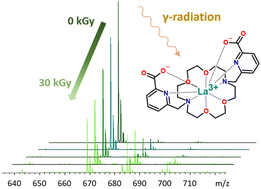
The growing use of radionuclides in nuclear medicine for therapy and diagnosis requires the development of chelators that combine high complexation performance with strong radiolytic stability. Macropa, an ether-crown ligand, displays a strong affinity for large trivalent cations and can be used as a chelator for radionuclides such as 225Ac, 149/161Tb, and 132/135La. Here, we investigated the γ-radiolysis of Macropa in water and evaluated the impact of complexation by studying Ln-Macropa complexes. Samples were irradiated up to 30 kGy, and degradation was monitored by ESI-MS and HPLC-ESI-MS, while quantification was made by 1H NMR. For free Macropa, the major degradation pathways involve carbon–carbon bond cleavages and the loss of the picolinate arm, together with additional minor hydroxylated and unsaturated products. In contrast, Ln-Macropa complexes mainly form hydroxylated products arising from HO˙ attack, and no La decomplexation was detected. Radiolytic degradation yields indicate that Macropa is already highly resistant (G0 ≈ −1.25 × 10⁻⁷ mol J−1) and that complexation with La further enhances stability (G0 ≈ −0.76 × 10⁻⁷ mol J−1). DFT calculations (BDE and Fukui indices) support these observations by showing increased C–C bond strengths upon La(III) complexation, as well as a shift in atomic positions most susceptible to radical attack from the crown ether to the pyridine ring of the carboxylate arm. Overall, these results highlight Macropa as a robust chelator under γ-irradiation and show that complexation can both improve stability and change degradation pathways toward products that preserve the ligand's chelating functions.
 Please wait while we load your content...


