


A rhenium-enhanced Cu nanowire catalyst for efficient electrocatalytic hydrogenation of furfural to furfuryl alcohol
 *a
*a
Abstract
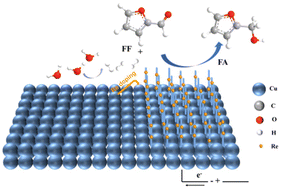
Biomass-derived furfural has become an ideal alternative to fossil fuels, capable of being converted into various high-value chemicals and fuels. Consequently, the study of highly efficient electrocatalyst systems for the hydrogenation of furfural (FF) to furfuryl alcohol (FA) has emerged as an effective approach to achieving green and sustainable development. In this study, we developed a highly efficient electrocatalyst for the hydrogenation of FF to FA by depositing rhenium (Re) on Cu nanowires, which achieves an ideal conversion of 99% and a yield of 92.5% in electrocatalytic reduction at −20 mA cm−2, with no significant performance degradation after five consecutive cycles. Various characterization analyses demonstrated that the deposition of Re enhanced the chemical adsorption capacity and improved the selectivity for FA production. In situ Fourier Transform Infrared (In situ FTIR) spectroscopy further revealed that Re doping boosts the adsorption of FF, and the strong electronic interaction between Re and Cu in the Re-decorated Cu nanowires enhances the selectivity for FA. This work demonstrates that tuning adsorption properties is an effective strategy to enhance the electrosynthesis of value-added biomass-derived chemicals.
 Please wait while we load your content...


