


 PLATFORM UPDATE:


A novel cadmium-containing porphyrin-based metal–organic framework enables oxidation of inert C(sp3)–H bonds
 *a
and
Chunying
Duan
a
*a
and
Chunying
Duan
a
Abstract
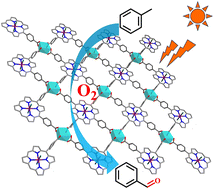
The selective oxidative functionalization of inert C(sp3)–H bonds under mild conditions remains a formidable challenge in catalysis. Herein, we report two isostructural two-dimensional cadmium porphyrin metal–organic frameworks (MnTCPP(Cd) and FeTCPP(Cd)) that address this challenge via a stepwise two-photon photocatalytic mechanism within their single-crystalline porous architectures. These frameworks are formed through solvothermal self-assembly of redox-active porphyrin linkers and Cd2+ nodes. These frameworks enable a stepwise two-photon process under 365 nm irradiation: the first photon induces oxidation of Cl− to chlorine radicals (Cl˙), which abstract hydrogen atoms from inert C(sp3)–H bonds via hydrogen atom transfer (HAT); the second photon subsequently activates O2 to generate superoxide radicals (˙O2−), driving the oxidation to form products. The confined microenvironment within the MOF channels synergistically regulates reactive oxygen species (ROS) generation and substrate activation, achieving highly selective oxidation of toluene to benzaldehyde under ambient conditions. Systematic investigations reveal that the central metal ion in the porphyrin core dictates the optical properties and charge separation efficiency, while the Cd nodes confer exceptional structural stability. Notably, MnTCPP(Cd) exhibits outstanding activity, excellent selectivity, and multi-cycle regeneration capability. This work demonstrates that judicious design of both ligands and metal nodes can effectively steer the photocatalytic performance of MOFs, offering a sustainable pathway for the activation of inert C(sp3)–H bonds through synergistic photocatalytic redox events.
 Please wait while we load your content...


