


Strongly axial monodentate carboxylate for dysprosium single-ion magnets

Abstract
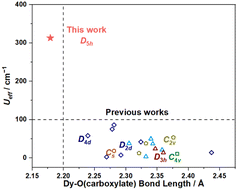
Recent breakthroughs in air-sensitive axial ligands have catalysed the development of high-performance dysprosium-based single-molecule magnets (Dy-SMMs) with exceptional magnetic blocking behaviour. However, air-stable axial ligands remain largely confined to phosphine oxides, phenols, and silanols. Carboxylates, despite being fundamental to early SMM chemistry, typically adopt bidentate coordination modes that usually weaken the magnetic anisotropy, thus limiting their utility as axial ligands. Herein, we report a highly anisotropic Dy-SMM featuring a monodentate carboxylate as the axial ligand, achieving the shortest Dy–O bond length and the highest effective energy barrier recorded to date for carboxylate-based systems. For comparison, two analogues incorporating phosphine oxide and phenolate axial ligands were synthesized. Comprehensive magnetic studies and ab initio calculations confirm that the thoughtfully designed coordination environment and local symmetry allow monodentate carboxylates to serve as strong, air-stable axial donors. Notably, the resulting magnetic anisotropy is positioned between that of phosphine oxide and phenolate ligands. Furthermore, partial charge calculations indicate that these variations in anisotropy stem from the disparate electronic charge distribution on the axial oxygen atoms. This work not only expands the family of air-stable Dy-SMMs but also offers guidance for the rational design of next-generation high-performance systems.
 Please wait while we load your content...


