In or out? Adaptive metal binding by a diphosphine-based Zr metal-organic cage

Abstract

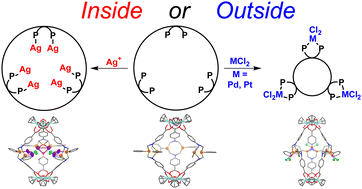
A lantern-type Zr metal-organic cage (MOC), Zr-P2N2, has been synthesized using ditopic carboxylate linkers based on the 1,5-diaza-3,7-diphosphacyclooctane (P2N2) ligand platform. Single-crystal X-ray diffraction shows that the diphosphine groups of the P2N2 linkers point into the confined MOC cavity. Postsynthetic metalation of the diphosphine groups with Pd and Pt precursors generates the heterobimetallic cages Zr-P2N2-PdCl2 and Zr-P2N2-PtCl2. Structural characterization reveals that the linkers flip to accommodate metal chelation, resulting in outward facing metal diphosphine groups. Conversely, reaction of Zr-P2N2 with AgPF6 results in formation of Zr-P2N2-Ag, which contains hexasilver core supported by phosphine complexation within the cage interior. This work highlights the adaptive structural behavior of Zr-P2N2 which provides new opportunities for designing responsive MOCs.
Supplementary files

Article information

Article type
Paper
Submitted
04 Mar 2026
Accepted
30 Mar 2026
First published
31 Mar 2026
This article is Open Access
Creative Commons BY-NC license

Dalton Trans., 2026, Accepted Manuscript

In or out? Adaptive metal binding by a diphosphine-based Zr metal-organic cage

J. Shin and C. R. Wade, Dalton Trans., 2026, Accepted Manuscript , DOI: 10.1039/D6DT00536E

This article is licensed under a Creative Commons Attribution-NonCommercial 3.0 Unported Licence. You can use material from this article in other publications, without requesting further permission from the RSC, provided that the correct acknowledgement is given and it is not used for commercial purposes.

To request permission to reproduce material from this article in a commercial publication, please go to the Copyright Clearance Center request page.

If you are an author contributing to an RSC publication, you do not need to request permission provided correct acknowledgement is given.

If you are the author of this article, you do not need to request permission to reproduce figures and diagrams provided correct acknowledgement is given. If you want to reproduce the whole article in a third-party commercial publication (excluding your thesis/dissertation for which permission is not required) please go to the Copyright Clearance Center request page.

Read more about how to correctly acknowledge RSC content.

Social activity

Spotlight

Advertisements