


 PLATFORM UPDATE:


Linker-dependent nitric oxide storage and release behavior in Cu-based metal–organic frameworks

Abstract
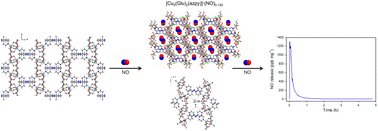
Nitric oxide (NO) is a small gaseous molecule whose controlled storage and release depend sensitively on host–guest interactions within porous materials. Herein, we report two structurally related copper-based metal–organic frameworks (Cu-MOFs) incorporating vinyl (–C![[double bond, length as m-dash]](https://www.rsc.org/images/entities/char_e001.gif) C–) and azo (–NN–) bipyridyl linkers, and investigate their NO storage and release behavior. Single-crystal X-ray diffraction analysis shows that NO molecules are reversibly accommodated within the pore channels through weak host–guest interactions, potentially involving non-classical hydrogen bonding, rather than direct coordination to the copper centers. Chemiluminescence measurements reveal that the vinyl-functionalized framework exhibits higher NO uptake with rapid release, whereas the azo-functionalized analogue displays lower uptake but more sustained release kinetics. Importantly, these results indicate that subtle variations in linker electronic structure correlate with differences in gas binding and release behavior, providing insight into linker-dependent control of gas–framework interactions.
C–) and azo (–NN–) bipyridyl linkers, and investigate their NO storage and release behavior. Single-crystal X-ray diffraction analysis shows that NO molecules are reversibly accommodated within the pore channels through weak host–guest interactions, potentially involving non-classical hydrogen bonding, rather than direct coordination to the copper centers. Chemiluminescence measurements reveal that the vinyl-functionalized framework exhibits higher NO uptake with rapid release, whereas the azo-functionalized analogue displays lower uptake but more sustained release kinetics. Importantly, these results indicate that subtle variations in linker electronic structure correlate with differences in gas binding and release behavior, providing insight into linker-dependent control of gas–framework interactions.
 Please wait while we load your content...


