


 PLATFORM UPDATE:


From cysteines to histidines – chemically distinct Cu(ii)-binding motifs in the C-terminal region of archaeal CopT regulators

Abstract
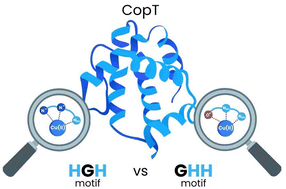
Copper-sensing transcriptional regulators of the CopT family play a central role in archaeal metal homeostasis, enabling adaptation to fluctuating copper availability. Their metal-binding properties have traditionally been rationalized almost exclusively in terms of cysteine-rich TRASH/YHS domains. Here we show that this view is incomplete, demonstrating that short histidine-containing C-terminal motifs outside the TRASH/YHS core possess an intrinsic capacity to form stable and chemically distinct Cu(II)-binding environments. Using minimal peptide models and a combined potentiometric, spectroscopic, and NMR approach, we show that the GHH motif displays a pronounced and persistent thermodynamic preference for both Cu(II) and Zn(II) over the HGH sequence across a broad pH range. Competition simulations demonstrate that this preference is not dictated by histidine spacing alone but correlates with donor-set composition, with glutamate carboxylates enabling early metal anchoring under mildly acidic conditions. Metal binding in both motifs is primarily driven by histidine residues. In the proposed coordination model, the surrounding donor environment is completed by glutamate side chains in the GEEGHH sequence, whereas in the HGH motif methionine occupies this complementary role, residing in close proximity to the Cu(II) coordination sphere and acting as a direct thioether donor in Zn(II) binding. Overall, these results identify histidine- and carboxylate-containing CopT C-terminal motifs as chemically distinct metal-binding elements and demonstrate how differences in donor-set composition encode differential Cu(II) and Zn(II) affinity independently of canonical cysteine-based domains.
 Please wait while we load your content...


