


 PLATFORM UPDATE:


Engineering oxaliplatin(iv) prodrugs with monohaloacetates for redox-responsive and multimodal anticancer activity
 a
Rebecca
Sodano,
b
Paolo
Paoli,
b
Iogann
Tolbatov,
c
Alessandro
Marrone,
d
Chiara
Gabbiani
ae
and
Alessandro
Pratesi
*ae
a
Rebecca
Sodano,
b
Paolo
Paoli,
b
Iogann
Tolbatov,
c
Alessandro
Marrone,
d
Chiara
Gabbiani
ae
and
Alessandro
Pratesi
*ae
Abstract
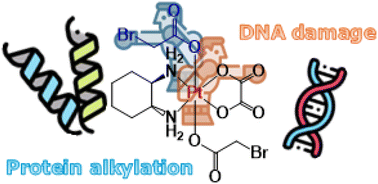
A series of novel oxaliplatin(IV) complexes bearing monohaloacetic acids (MAAs) were synthesised to address the limitations of platinum-based chemotherapy related to severe side effects and resistance phenomena. Both symmetrical [Pt(DACH)(ox)(MAA)2] and asymmetrical [Pt(DACH)(ox)(MAA)(OAc)] derivatives featuring monofluoroacetate, monochloroacetate, or monobromoacetate were fully characterised (multi-nuclear NMR, elemental analysis) and evaluated for aqueous solubility, stability in DMSO and phosphate-buffered saline, and redox behaviour via cyclic voltammetry. Reduction assays with dithiothreitol confirmed efficient Pt(IV) → Pt(II) conversion on timescales compatible with physiological conditions. Cytotoxicity studies on human ovarian carcinoma A2780 cells under normoxic and hypoxic environments highlighted increased activity under hypoxia, suggesting preferential prodrug activation in a reducing tumour-like milieu. Asymmetrical complexes generally offered improved solubility and promising antiproliferative profiles, whereas certain monobromoacetate-containing derivatives displayed partial instability linked to the higher leaving group ability of bromide. Notably, mechanistic investigations indicated that the enhanced cytotoxicity of selected bromoacetate-functionalised complexes is not associated with increased DNA damage relative to oxaliplatin, suggesting the contribution of additional non-genomic pathways. These findings emphasise the promise of monohaloacetate-functionalised oxaliplatin(IV) complexes as multimodal prodrugs combining platinum-mediated cytotoxicity with complementary bioactive mechanisms for improved anticancer efficacy.
 Please wait while we load your content...


