


 PLATFORM UPDATE:


Molybdenum(vi) borano–imido complexes and their application as Lewis acid catalysts in homocoupling of diazo compounds
 *a
Michaela
Buziková,
a
Michał
Jakubczyk,
a
Krishna
Pattanamcheril Anilkumar,
ab
Jan
Demel
a
and
Miroslava
Litecká
a
*a
Michaela
Buziková,
a
Michał
Jakubczyk,
a
Krishna
Pattanamcheril Anilkumar,
ab
Jan
Demel
a
and
Miroslava
Litecká
a
Abstract
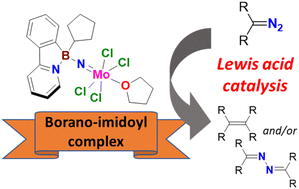
We report the synthesis, structural characterization, and catalytic activity of a borano–imido molybdenum complex featuring a unique motif B–N![[double bond, length as m-dash]](https://www.rsc.org/images/entities/char_e001.gif) MoCl4(thf), prepared via the reaction of a phenylpyridine-based boron azide with [MoCl4(thf)2]. Spectroscopic and crystallographic analyses confirmed the formation of a linear B–N–Mo(VI) linkage. Reaction of the formed imido complex with various neutral donors resulted in solvent-assisted reduction and formation of several structurally diverse Mo(V) derivatives, showing the adaptability of the imido framework. The Mo(VI) imido complex acts as a strong Lewis acid and efficiently catalyses the homocoupling of diazo compounds under mild conditions. For diaryldiazomethanes, the product selectivity between tetraarylethylenes and azines is primarily governed by the electronic nature of the substituents: electron-donating groups favor the formation of tetraarylethylenes, whereas electron-withdrawing groups lead exclusively to 1,2-bis(diarylmethylene)hydrazines. The complex also mediated the transformation of 1-diazoindenes to afford either 1,1′-biindene or bis(1,2-indenylidene)hydrazines, with the selectivity controlled by steric effects. Furthermore, α-diazophenylacetates were efficiently coupled to yield mixtures of maleates and fumarates, accompanied by minor amounts of azine by-product, with negligible influence of solvent or substituent variation.
MoCl4(thf), prepared via the reaction of a phenylpyridine-based boron azide with [MoCl4(thf)2]. Spectroscopic and crystallographic analyses confirmed the formation of a linear B–N–Mo(VI) linkage. Reaction of the formed imido complex with various neutral donors resulted in solvent-assisted reduction and formation of several structurally diverse Mo(V) derivatives, showing the adaptability of the imido framework. The Mo(VI) imido complex acts as a strong Lewis acid and efficiently catalyses the homocoupling of diazo compounds under mild conditions. For diaryldiazomethanes, the product selectivity between tetraarylethylenes and azines is primarily governed by the electronic nature of the substituents: electron-donating groups favor the formation of tetraarylethylenes, whereas electron-withdrawing groups lead exclusively to 1,2-bis(diarylmethylene)hydrazines. The complex also mediated the transformation of 1-diazoindenes to afford either 1,1′-biindene or bis(1,2-indenylidene)hydrazines, with the selectivity controlled by steric effects. Furthermore, α-diazophenylacetates were efficiently coupled to yield mixtures of maleates and fumarates, accompanied by minor amounts of azine by-product, with negligible influence of solvent or substituent variation.
 Please wait while we load your content...


