


 PLATFORM UPDATE:


Fe-doped NiCoP nanosheet arrays rich in phosphorus vacancies for highly efficient electrochemical water splitting
 *a
*a
Abstract
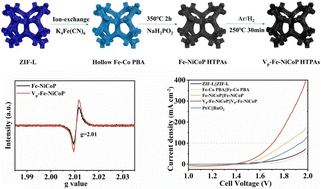
Transition metal phosphides (TMPs) have emerged as highly active bifunctional electrocatalysts, owing to their excellent conductivity and tunable electronic structure. However, a major bottleneck for TMP-based catalysts is their limited active-site accessibility and insufficient operational durability, which together impede their practical adoption. In this work, Vp–Fe–NiCoP (Fe-doped NiCoP nanosheet arrays with abundant phosphorus vacancies) was prepared via a metal–organic-framework (MOF)-to-MOF strategy followed by phosphorization and H2 reduction. MOF-derived nanosheets offer an extensively exposed active surface along with shortened pathways for charge transport, thereby enhancing reaction kinetics. The synergistic combination of Fe doping and P vacancies fine-tunes the electronic structure of the electrocatalyst, resulting in improved intrinsic conductivity and a higher density of active sites. Consequently, Vp–Fe–NiCoP exhibits outstanding activity in 1.0 M KOH, requiring overpotentials of only 240 mV for the oxygen evolution reaction (OER) and 164 mV for the hydrogen evolution reaction (HER) at 100 mA cm−2. Moreover, it maintains excellent stability, showing negligible potential variation after 250 h of OER and 140 h of HER operation at the same current density. The integrated two-electrode cell achieves a current density of 100 mA cm−2 at a cell voltage of only 1.7 V. The exceptional activity and robust stability demonstrated here validate the designed material as a high-performance bifunctional electrocatalyst suitable for efficient water splitting.
 Please wait while we load your content...


