


 PLATFORM UPDATE:


Effects of intercalated anions on the interfacial oxygen evolution activity and selectivity of NiFe(OH)2 nanosheet array electrodes for seawater electrolysis
 d
and
Hui
Wang
*c
d
and
Hui
Wang
*c
Abstract
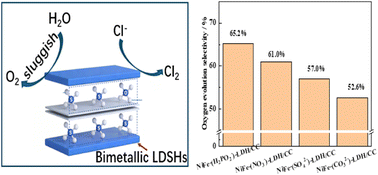
Nickel–iron layered double hydroxides (NiFe-LDHs) are widely recognized as highly effective components for oxygen evolution reaction (OER) catalysis. However, their interfacial OER activity and selectivity under seawater electrolysis conditions remain insufficiently explored. In seawater electrolysis, the competitive chlorine evolution reaction (CER) is a major factor leading to reduced anode efficiency and accelerated electrode corrosion. To enhance the catalytic activity of interfacial sites in NiFe-LDHs while suppressing chlorine evolution, this study introduces various anions—including NO3−, CO32−, SO42−, and H2PO2−—into the interlayer galleries of NiFe-LDHs. Anion intercalation effectively modulates the oxidation states of Ni and Fe, strengthens OH− adsorption, and consequently improves both the OER activity and selectivity of the catalyst. In alkaline seawater electrolyte, the optimized electrode delivers a current density of 100 mA cm−2 at an overpotential of only 288 mV and mass activities of 24.2 mA mg−1 and 290.1 mA mg−1 at 1.50 V and 1.58 V, while exhibiting outstanding durability, with a negligible LSV shift of merely 4 mV after 6000 cyclic voltammetry cycles. Furthermore, measurements conducted in natural seawater reveal that H2PO2−-intercalated NiFe-LDH supported on carbon cloth achieves the highest oxygen evolution selectivity, reaching 65.2%. These results confirm that introducing functional anions into the interlayer region represents a viable route to improve OER selectivity during seawater electrolysis. Moreover, this strategy offers a rational framework for engineering highly efficient catalytic systems tailored for the direct utilization of natural seawater in hydrogen production applications.
 Please wait while we load your content...


