


 PLATFORM UPDATE:


Cr2MoAlC2 MAX phase and its derivative Cr2MoC2Tx MXene for supercapacitors and electrocatalytic water splitting

Abstract
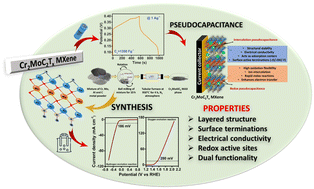
The expanding research on 2D MXenes has enabled new strategies to engineer material properties via structural design. While bimetallic or double transition metal (DTM) MXenes have continued to gain attention since their emergence in 2015, their versatile structure and exceptional physicochemical properties have inspired wide exploration. This study reports the synthesis of the Cr2MoAlC2 MAX phase and its derivative Cr2MoC2Tx MXene (Tx = –F/–OH/–O), leveraging the synergistic incorporation of Cr and Mo as dual transition metals. The structural, thermal, chemical, and surface morphology characteristics were analyzed using various techniques. Cr2MoC2Tx MXene exhibits superior pseudocapacitance performance as an electrode material, achieving a specific capacitance of 1350 F g−1 at 1 A g−1 with 84% retention over 5000 cycles. In a two-electrode asymmetric device, Cr2MoC2Tx MXene delivers a specific capacitance of 438.3 F g−1 at 1 A g−1, an energy density of ∼87.66 Wh kg−1, and a power density of 1200 W kg−1. Additionally, Cr2MoC2Tx MXene demonstrates excellent electrocatalytic activity for water splitting applications, with overpotentials of 186 mV for the hydrogen evolution reaction (HER) and 280 mV for the oxygen evolution reaction (OER), at 10 mA cm−2. This dual functionality, driven by the synergistic interaction between Cr and Mo, establishes Cr2MoC2Tx MXene as a promising material for both energy storage and hydrogen production, positioning it as a competitive candidate among state-of-the-art materials. Furthermore, this research aligns with the United Nations Sustainable Development Goal (SDG) 7, contributing to the advancement of high-performance electrode materials for next-generation electrochemical applications.
 Please wait while we load your content...


