


 PLATFORM UPDATE:


Tuning magnetic exchange and relaxation dynamics in dinuclear Dy(iii) single-molecule magnets via co-ligand modulation on a hydrazone-based Schiff base platform

Abstract
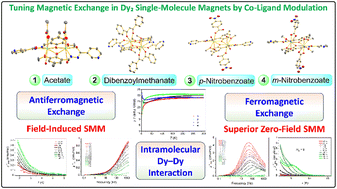
A new hydrazone-based Schiff base ligand, (E)-N′-(2-hydroxy-3-methoxy-5-methylbenzylidene)nicotinohydrazide (H2L), has been employed for the synthesis of a family of four dinuclear Dy(III) complexes, [Dy2(L)2(OAc)2(H2O)2]·H2O (1), [Dy2(L)(dbm)2(CH3OH)2]·2CH2Cl2 (2), [Dy2(L)(pnba)2(H2O)0.8(CH3OH)1.2]·2H2O·2.8CH3OH (3), and [Dy2(L)2(mnba)2(H2O)2(CH3OH)2]·2CH3OH (4), obtained through systematic variation of ancillary anionic co-ligands. Single-crystal X-ray diffraction reveals that all complexes feature a closely related diphenoxide-bridged {Dy2(L)2} core, while the Dy(III) centers adopt distorted eight- or nine-coordinate geometries depending on the co-ligand environment. Direct-current magnetic measurements show that complexes 1 and 2 display an overall antiferromagnetic (AFM) signature at low temperatures, whereas complexes 3 and 4 exhibit dominant ferromagnetic (FM) coupling. Ab initio calculations reveal that the intramolecular Dy–Dy interaction involves an interplay between a FM dipolar coupling and AFM exchange. In complexes 1 and 2, the AFM interaction dominates the bulk magnetic response while complexes 3 and 4 exhibit a FM curve profile. This interplay has a decisive impact on the single-molecule magnet (SMM) properties. As a consequence, complexes 1 and 2 exhibit only weak, field-induced slow magnetic relaxation due to enhanced quantum tunneling of magnetization, whereas complexes 3 and 4 display clear zero-field SMM behavior with superior relaxation performance. Theoretical analysis further demonstrates that co-ligand-dependent coordination geometries control the orientation of the magnetic easy axes and modulate the effectiveness of magnetic coupling, thereby establishing a direct correlation between the overall magnetic interaction and the observed SMM behavior in this dinuclear Dy(III) family.
 Please wait while we load your content...


