


Molecular mechanisms behind the potential genotoxicity of metal oxide nanoparticles: nucleoside deglycosylation pathway

Abstract
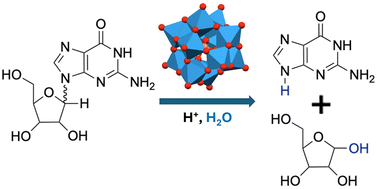
Polyoxometalates (POMs) represent well-defined molecular models for metal oxide nanoparticles and provide valuable insight into their interactions with biomolecules. Here, we investigate the interaction of Keggin-type phosphotungstic (H3PW12O40) and silicotungstic (H4SiW12O40) acids with RNA-derived nucleosides cytidine and guanosine, showing for the first time that these POMs can act as catalysts for the deglycosylation of nucleosides and provide a possible molecular mechanism that facilitates this process. These systems provide useful molecular-level models for metal oxide nanoparticle–biomolecule interactions and potential RNA deglycosylation pathways. Six crystalline complexes were obtained and structurally characterized by single-crystal X-ray diffraction, revealing extensive hydrogen bonding networks and pronounced interactions between nucleobases and the POM surfaces associated with charge transfer. In several cases, catalytic deglycosylation of nucleosides occurred during crystallization, yielding nucleobase–POM complexes and providing direct structural evidence of nucleoside cleavage. Complementary solution studies performed by 1H NMR demonstrated rapid and selective catalytic deglycosylation of guanosine by silicotungstate under acidic near-boiling conditions, following apparent first-order kinetics (k = 0.399 min−1), whereas cytidine reacted rather slowly, yielding only trace amounts of cytosine complexes. Phosphotungstate anions revealed analogous but slower reactivity. Control experiments showed no comparable catalytic activity for TiO2 nanoparticle models (TiBALDH) under identical conditions. The results highlight pronounced differences in reactivity between purine and pyrimidine nucleosides and emphasize the role of charge-transfer and hydrogen-bonding interactions in POM-mediated catalysis. These findings provide molecular-level insight into metal oxide–biomolecule interactions and support the use of POMs as tunable models for understanding potential RNA degradation pathways induced by metal oxide nanoparticles.
- This article is part of the themed collection: Inorganic Nanomaterials
 Please wait while we load your content...


