


 PLATFORM UPDATE:


Beyond layer stacking: molecular Ru2O9 dimer correlations in pressure-synthesized Ba3NbRu2O9
 *a
*a
Abstract
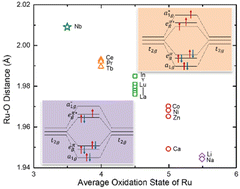
Ruthenium-based oxides featuring face-sharing octahedra provide a powerful chemical platform for tuning correlated electronic states through direct metal–metal interactions and valence control. Here we report the high-pressure, high-temperature synthesis and comprehensive characterization of Ba3NbRu2O9, a previously unreported 6H-type hexagonal perovskite. Single-crystal and powder X-ray diffraction measurements confirm a fully ordered structure composed of face-sharing Ru2O9 dimers separated by corner-sharing NbO6 octahedra, crystallizing in the P63/mmc space group. Charge balance analysis reveals an unusually low mixed Ru3+/Ru4+ oxidation state (nominal Ru3.5+), representing a reduced Ru valence realized within the Ba3MRu2O9 family. Magnetic susceptibility measurements show Curie–Weiss behavior at high temperatures with an effective magnetic moment of 2.39μB per formula unit and a negative Curie–Weiss temperature, indicating predominant antiferromagnetic interactions. Below ∼15 K, a bifurcation between zero-field-cooled and field-cooled susceptibilities emerges, while the absence of a frequency-dependent shift in AC susceptibility and the lack of a λ-type anomaly in specific heat down to 1.8 K indicate a frozen spin state with short-range correlations rather than long-range magnetic order or a canonical spin-glass transition. Electrical transport measurements reveal a broad resistivity maximum near 35 K followed by a low-temperature upturn and pronounced positive magnetoresistance. Remarkably, the temperature dependence of resistance closely resembles that of the nine-layer BaRuO3 polytype, despite the structural similarity of Ba3NbRu2O9 to the four-layer phase. These results demonstrate that the electronic and magnetic properties of Ba3NbRu2O9 are governed primarily by the molecular electronic state of the Ru2O9 dimers rather than by crystallographic stacking alone, underscoring the central role of dimer-based correlations in low-valence ruthenates.
 Please wait while we load your content...


